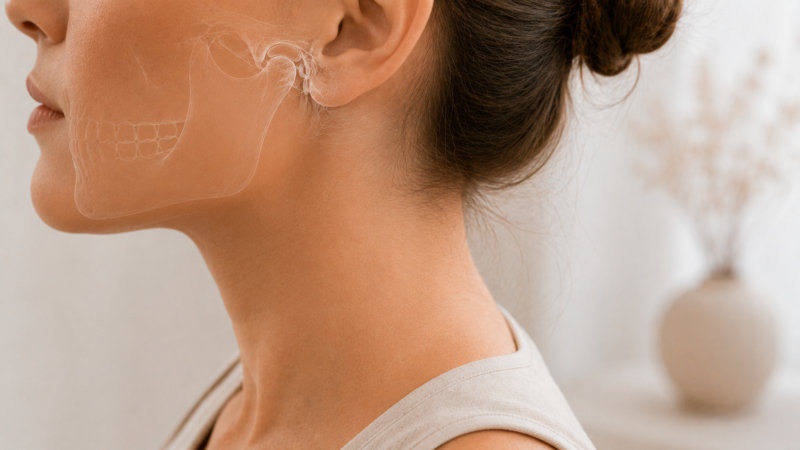

TMJ pain is often treated as an isolated jaw problem. But for many patients with complex pain, the jaw is only one part of a larger head, neck, nerve, and connective tissue pattern.
The temporomandibular joint does not work alone. Jaw position is influenced by the cervical spine, posture, muscle guarding, migraine activity, trigeminal nerve sensitivity, and systemic inflammation. When these systems are evaluated separately, the true driver of TMJ pain can be missed.
Hypermobility and Jaw Guarding
In patients with hypermobility or Ehlers-Danlos syndrome, the ligaments that support the jaw joint may be too lax. When the TMJ is not stable, the surrounding muscles often tighten to protect it.
The masseter, temporalis, and pterygoid muscles may begin working overtime to control jaw motion. This can create tightness, aching, clenching, restricted opening, clicking, popping, or a feeling that the jaw is stuck.
In some patients, the jaw muscles are not the original problem. They are guarding because the joint lacks stability.
The Neck and TMJ Connection
Jaw mechanics are closely tied to head and neck position. When the cervical spine is irritated, unstable, or held in a compensated posture, the jaw may be forced to move under abnormal strain.
In patients with craniocervical instability, whiplash history, or hypermobility, the muscles at the base of the skull may tighten to protect the upper neck. That tension can transmit into the jaw and facial muscles, contributing to TMJ pain.
Lower cervical issues can also affect posture and muscle tone, keeping the jaw in a stressed position.
The Trigeminal Nerve and Migraine Loop
The trigeminal nerve processes sensation from the face and helps control jaw muscles. This creates a close relationship between TMJ pain, facial pain, migraine, and neck pain.
Migraine can trigger jaw clenching and facial tension. Chronic jaw guarding can also irritate trigeminal nerve pathways and lower the migraine threshold.
Some patients experience sharp, electric, or ear-centered pain that may come from nerve irritation rather than the jaw joint alone.
Inflammation Can Add Another Layer
Autoimmune or inflammatory conditions, including Sjögren’s disease and psoriatic arthritis, may affect the TMJ and upper cervical joints. Inflammation can worsen pain, swelling, laxity, and muscle guarding.
Our Approach at MPM
At Manhattan Pain Medicine, we evaluate TMJ pain through the full head-neck system, helping patients identify whether symptoms are coming from jaw instability, cervical spine dysfunction, migraine, trigeminal nerve irritation, hypermobility, inflammation, or a layered pain pattern.